

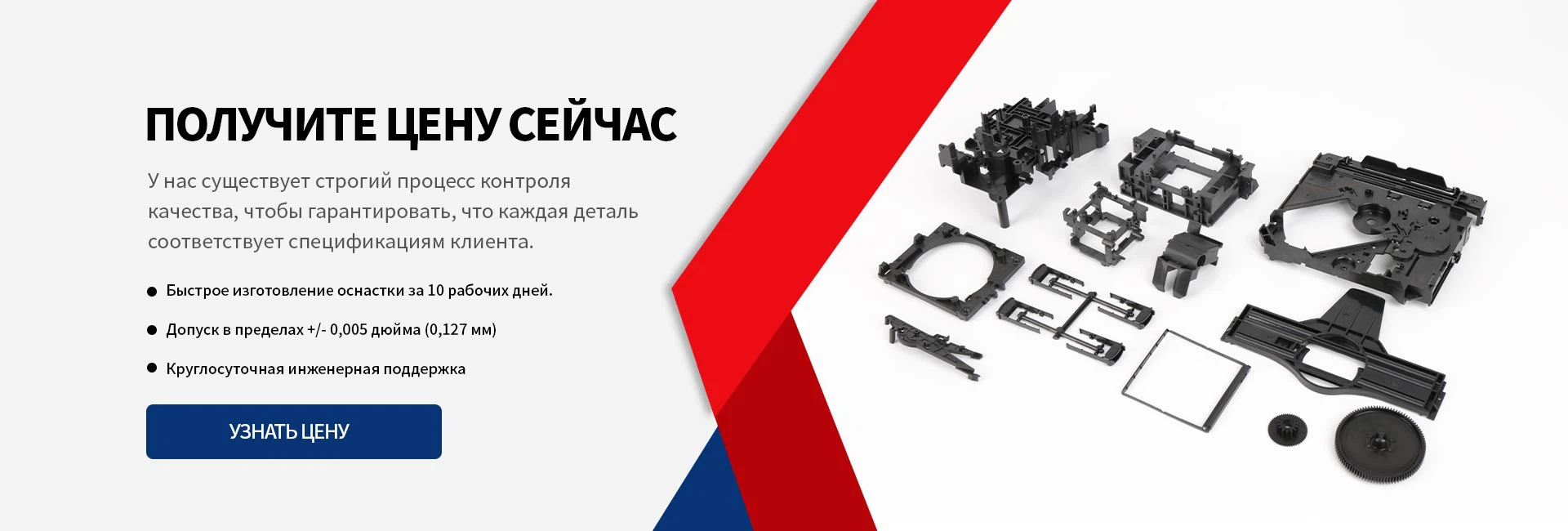
Plastic casting process
We can produce details from various materials, including thermoplasts, elastomers and silicone . In addition, we offer additional services, such as processing, decoration and assembly .}}}}

Production of forms
The process of manufacturing the form can be quite complicated and expensive in time, but this is an important part of the plastic casting process . usually the process ends within 2 weeks .}}}}

Pressure casting
The process of plastic casting allows you to quickly and effectively produce a large number of parts . It is ideal for the production of complex parts with accurate tolerances .}}}

Formation of inserts
Place the insert in the press form and form around it to extend the life of the tool of key functions, this allows you to form inserts, such as brass nuts in your structure .}}}}}

Overmold
The installation of pre -made parts in the form, and then their coating with new material . This two -stage process provides flexibility of the design of multi -material parts by creating forms with various structural materials .}}}}}}

The process of pressure under pressure is a standard operating procedure for the production of large volumes of finished plastic parts used in industrial applications .}}
The technology of plastic casting under pressure is to inject molten resin into a metal cavity under high pressure . Then the form is quickly cooled for the formation of a solid form {{1}
Why choose a plastic casting under pressure
Redexpart - Professional Supplier of plastic casting services under pressure .
Here are four reasons to use our plastic casting procedure under pressure:
Endless production opportunities
Redexpart capabilities include various plastic molding technologies . Plastic molding machines are presented from 60 to 1800 tons.}}}}}
Checking materials
Redexpart issues a report on the verification of materials for each order for plastic casting under pressure . In addition, we offer certificates of conformity for all the materials used .}}}
Production support
We optimize the costs of manufacturing products by plastic casting under pressure, providing each client with detailed reports on the design for production .}}}
Program optimization program
We combine data from thousands of projects with our own materials and forming procedures . The process optimization can quickly determine the correct processing parameters .}}}}
Pressure casting


Pressure casting process
Step 1
Plastic resin is supplied in the form of raw granules . The granules are dried until the necessary humidity is achieved . if necessary, they can be mixed with pigments or dyes of masterbatch .}}}}}}
Step 2
The dried granules are added to the loading device of the cast vehicle . inside the barrel of the casting machine is the back-rotating screw that moves the granules to the form .}}}}
Step 3
The granules are heated and mixed until they reach a fully molten state and become liquid resin . The heating elements maintain the temperature inside the barrel at a stable level for the resin type used.}}}
Step 4
The heated press-form is automatically closed ., which is under high pressure, is injected into the press-form cavity through the shutter, through the opening of the injective pin, the displaced air for the casting of products under pressure.}}}
Step 5
The form is cooled for hardening the inner part . The cooling time depends on the type of resin and thickness of the part . The temperature of the form is controlled by internal cooling or heating systems, where water circulates.}}}}}}}
Step 6
The form opens, the drawer rod moves forward to push the part and start a new cycle .
Pressure casting materials

Abs
Smol of acrylonitril-tadien-styrola is a milky-white solid with a certain℃of rigidity, the density of which is about 1.04 ~ 1.06 g/cm 3. ABS-this is a resin that has good mechanical strength, wide temperature range, good stability of size, chemical resistance, electrical insulation, electrical insulation. properties and simplicity in production .}
General areas of application:
Dashboard, refrigerator, phone, keyboard

ABS / PC
PC + ABS plastic provides a higher strength than ABS at a lower cost than PC . it has high shock viscosity even at low temperatures . In addition, the addition of fiberglass, mineral fillers and antipyrens can change its characteristics .
General areas of application:
Electrical equipment, computers, auto parts

Nylon 6
Also known as P6, polyamide 6, is a polymer connection . with the exception of a low melting point and a wide range of operating temperatures, its chemical and physical properties are very similar to nylon 66. among all types of nylon, nylon 6 has the smallest elastic modulus .}}}}}}}}}}}}}}}}}}
General applications:
Structural components, bearings

Nylon 66
Polygexamethylenadipamide, usually known as nylon -66, is a thermoplastic resin . The productivity of nylon 6-6 is better than that of nylon 6, and the price is not as expensive as nylon {4} its resistance to wear, and mechanical strength, hardness and rigidity are very much High . can be used as engineering plastic for the manufacture of synthetic fibers .
General applications:
Auto parts, devices

Polycarbonate
This is a highly molecular weight polymer containing carbonate groups in the molecular chain . This is a strong thermoplastic resin with fire resistance and antioxidant . has excellent impact, transparency, optical properties and mechanical characteristics, and can also be cast with high accuracy .}} A wide range of application, and there are many different compositions for choosing.
General applications:
Computer components, connectors, auto parts

PE
Полиэтилен - это самый простой полимерный органический соединение и наиболее широко используемый полимерный материал. Существуют два типа ПЭ в зависимости от плотности: ПЭНП (низкой плотности) и ПЭВП (высокой плотности). Он обладает хорошей смазываемостью и легко обрабатывается. Следует отметить, что он очень мягкий и не может использоваться при температуре значительно выше 150 degrees .
General applications:
Corps

Pnd
Low density polyethylene, also known as high -pressure polyethylene (PND), are milky -white, without smell, tasteless, non -toxic and waxy particles with a matte surface . have a good electrical insulation, transparency, ease of processing and a certain air permeability. that has high tendency and flexibility, which Provides excellent impact resistance . This is compensated by constant deformation after a blow .}}
General applications:
Bowls, cabinets, pipe couplings

PVD
High density polyethylene (PVD) is a white powder or granular product . is non -toxic and without smell, the temperature of use can reach 100 Degree . it does not have an impact strength of PND, but it is more elastic . Superficial hardness, stiffness and other mechanical characteristics than that PND, close to PP, elasticity exceeds the PP, but the surface finish is not as good as that of PP .}}}
General applications:
Storage containers, kitchen utensils, sealing lids

PAT
Polyethyleneterftalate, lactic-white or light yellow, is a highly reduced polymer with a smooth and shiny surface . it is non-toxic, tasteless, has good hygiene and safety, and can be directly used for packaging of food products .} the temperature range, and the long -term use temperature can reach 120 Degree {{5}, however, it is difficult to form with very accurate tolerances .}}}
Ordinary applications:
Automotive industry, electrical components

Paragraphs
Polypropylene is abbreviated as PP, this is a colorless, no -toxic, translucent solid {0}} The density is about 0, { close tolerances . are widely used in the production of clothing, medical equipment, cars, bicycles, parts, pipelines, chemical containers, etc.
General areas of application:
Automotive industry (wings, ventilation ducts, fans) .

Pap
This is a type of synthetic resin with high hardness, strength, good chemical resistance and low cost . due to the excellent physical, thermal and electrical properties of PPA, and especially the moderate cost, it has a wide range of application . despite the relatively later PPA, its good design data still remains very much useful .
General applications:
Corps

PPS (polyphenylene sulfide)
This is a new type of high -performance thermoplastic resin, which has the advantages of high mechanical strength, resistance to high temperatures, chemical resistance, fire resistance, good thermal stability and excellent electrical properties . It is widely used in areas of electronics, automotive, engineering and chemical industry .}}}
General applications:
Corps

Pom
This is crystalline plastic with a density of 1.42 g/cm³ . it has good rigidity and is engineering plastic with excellent complex properties . POM has problems with the release of gases at high temperatures and it becomes fragile at low temperatures . by the℃of filling with glass and adding lubricants, but there is no℃of fire resistance .
General applications:
Gears, bearings, pipe components

Pu
Polyurethane, this is an extremely elastic, wear -resistant and durable elastic material that can be used in formulas based on ether . these different formulas cover a very wide range of hardness and density .}}}}
Ordinary applications:
Corps
Surveying surface finishes under pressure
|
Image |
Level |
Finishing |
Descriptions |
 |
A1, A2, A3 |
Glossy |
The surface is completely smooth, not allowing defects or scratches, similar to the effect of the reflection of the mirror .}} |
 |
B1, B2, B3 |
Half -gloss |
The surface is smooth and without obvious defects, but small scratches and spots are allowed . |
 |
x1, x2, x3 |
Matte |
The surface without shine and slightly rough, but does not affect the functionality . |
 |
T1, T2, T3 |
Textured |
For some special requirements, such as anti -slip, wear -resistant and others . |
Why choose Redexpart
Based on data obtained from thousands of projects, together with standard materials and molding processes, our pressure processing process is an optimization program that effectively determines the correct combination of processing parameters for any this project .}}}
Using this information, we can translate a new form from testing in just a few hours . by applying the correct combination of processing parameters necessary for the correct filling of the part, we can reduce or even exclude defects of plastic parts during the process of pressure .}}}}}}}}}
Thanks to the optimization of the Redexpart process, quality problems caused by built -in stresses are eliminated:
- curvature
- Flower mixing
- Cracks
- Surfacing
- Void
- surface immersion
- Underloading
- The gloss of the surface

Frequently asked questions about pressure under pressure
Q: How soon can I get an accurate proposal for the manufacture of an individual plastic part by the method of pressure?
Q: What is the typical period of execution of the project under pressure?
Q: What services do you provide?
Q: What is included in the design of forming forms under pressure?
Click on the next button to get a free quotation according to your project right now .
All information is protected and confidential .